
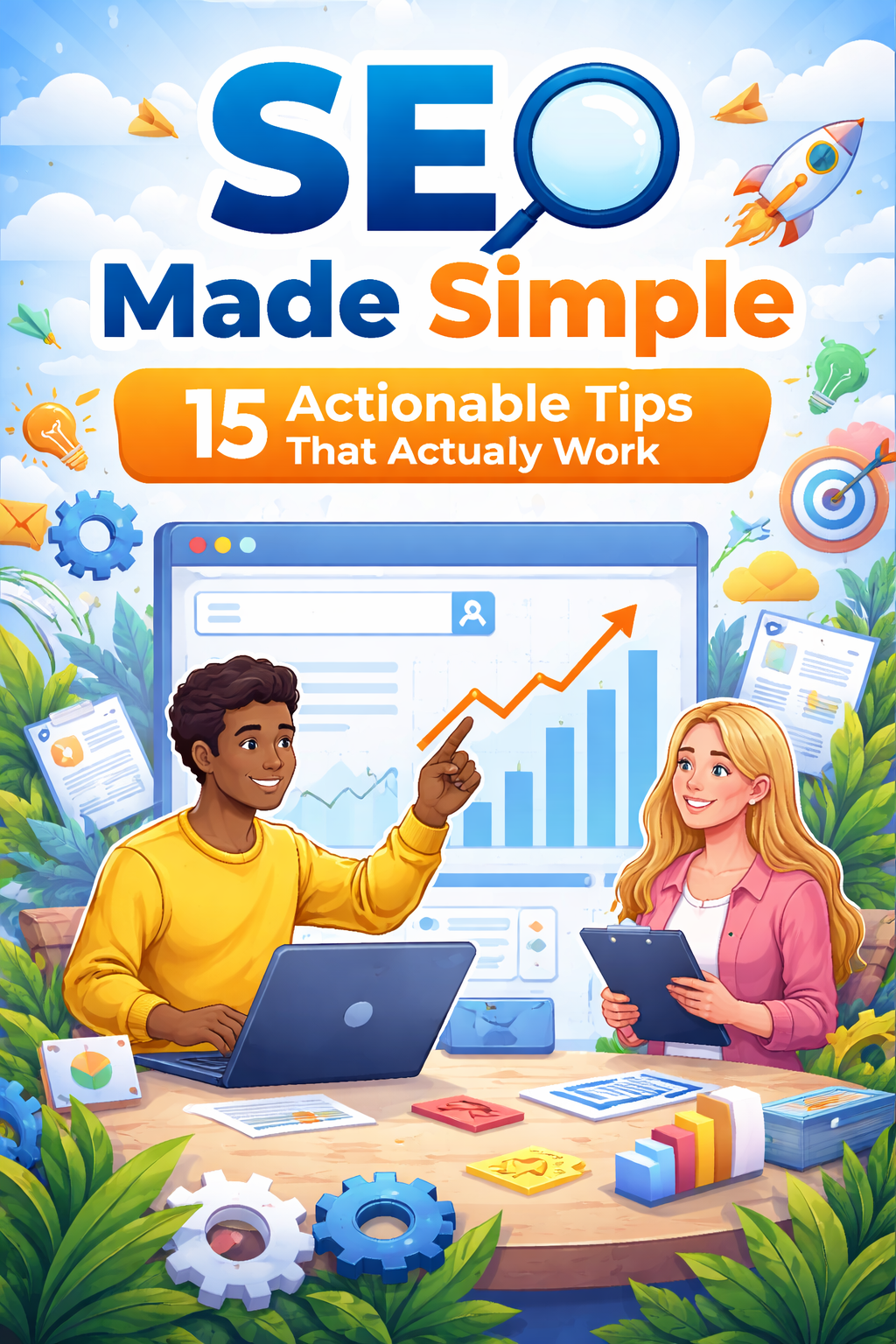


SEO Made Simple: 15 Actionable Tips That Actually Work explains practical, beginner-friendly strategies to improve rankings, increase traffic, and grow online visibility.
Comprehensive SEO Outline (Table Format)
| Heading Level | Topic |
|---|---|
| H1 | SEO Made Simple: 15 Actionable Tips That Actually Work |
| H2 | Understanding SEO in Simple Terms |
| H3 | What SEO Really Means |
| H3 | Why SEO Still Matters in 2026 |
| H2 | How Search Engines Work |
| H3 | Crawling, Indexing, and Ranking |
| H4 | Google Algorithm Basics |
| H2 | Tip 1: Do Smart Keyword Research |
| H3 | Search Intent Explained |
| H2 | Tip 2: Optimize Titles and Meta Descriptions |
| H2 | Tip 3: Create High-Quality, Helpful Content |
| H3 | E-E-A-T Explained |
| H2 | Tip 4: Use Headings Properly (H1–H6) |
| H2 | Tip 5: Improve Website Speed |
| H3 | Core Web Vitals |
| H2 | Tip 6: Make Your Site Mobile-Friendly |
| H2 | Tip 7: Optimize Images for SEO |
| H2 | Tip 8: Build Internal Links |
| H2 | Tip 9: Earn High-Quality Backlinks |
| H3 | White-Hat Link Building |
| H2 | Tip 10: Optimize for Local SEO |
| H2 | Tip 11: Use SEO-Friendly URLs |
| H2 | Tip 12: Fix Technical SEO Issues |
| H2 | Tip 13: Refresh Old Content |
| H2 | Tip 14: Track SEO Performance |
| H2 | Tip 15: Stay Updated with SEO Trends |
| H2 | Frequently Asked Questions (FAQs) |
| H2 | Conclusion: SEO Success Made Simple |
Understanding SEO in Simple Terms
Search Engine Optimization, commonly known as SEO, is the process of improving your website so it appears higher in search engine results. SEO Made Simple: 15 Actionable Tips That Actually Work is designed to remove confusion and focus on what truly helps your website grow.
SEO is not about tricking Google. Instead, it’s about helping search engines understand your content and showing users exactly what they’re looking for. When done correctly, SEO brings consistent, long-term traffic without relying on paid ads.
What SEO Really Means
At its core, SEO means:
- Creating helpful content
- Making your website easy to use
- Showing search engines that your site is trustworthy
When these elements work together, your site naturally ranks higher.





Why SEO Still Matters in 2026
Despite the rise of social media and AI tools, search engines remain the top source of website traffic. Google processes billions of searches daily, and users trust organic results more than ads. Businesses that ignore SEO often struggle to compete online.
How Search Engines Work
Understanding how search engines work makes SEO far easier to apply.
Crawling, Indexing, and Ranking
Search engines follow a three-step process:
- Crawling – Bots scan web pages
- Indexing – Pages are stored in a database
- Ranking – Pages are ordered based on relevance and quality
Google Algorithm Basics
Google’s algorithm evaluates hundreds of factors, including content quality, backlinks, page speed, and user experience. While the algorithm changes often, its goal remains the same: provide the best possible answer.
Tip 1: Do Smart Keyword Research
Keyword research is the foundation of SEO success. Choose keywords people actually search for and match them with user intent.
Search Intent Explained
There are four main types of search intent:
- Informational
- Navigational
- Commercial
- Transactional
Matching your content to intent improves rankings and engagement.
Tip 2: Optimize Titles and Meta Descriptions
Your title tag and meta description are the first things users see in search results. A clear, compelling title improves click-through rates and rankings.
Best practices include:
- Use your main keyword naturally
- Keep titles under 60 characters
- Write descriptions that encourage clicks
Tip 3: Create High-Quality, Helpful Content
Content is still king. Google rewards pages that answer questions clearly and thoroughly.
E-E-A-T Explained
E-E-A-T stands for:
- Experience
- Expertise
- Authority
- Trustworthiness
To improve E-E-A-T:
- Use accurate information
- Cite credible sources like
👉 https://developers.google.com/search/docs - Write with clarity and confidence
Tip 4: Use Headings Properly (H1–H6)
Headings organize your content and help both users and search engines understand your page. Always use one H1, followed by structured subheadings.
Tip 5: Improve Website Speed
Fast websites rank better and keep visitors longer.
Core Web Vitals
Google measures:
- Loading speed
- Interactivity
- Visual stability
Compress images, use caching, and choose reliable hosting to improve speed.
Tip 6: Make Your Site Mobile-Friendly
More than half of web traffic comes from mobile devices. A responsive design ensures your site works well on all screen sizes.
Tip 7: Optimize Images for SEO
Images should load fast and include descriptive alt text. This improves accessibility and image search visibility.
Tip 8: Build Internal Links
Internal links help search engines discover pages and distribute authority across your site. They also keep users engaged longer.
Tip 9: Earn High-Quality Backlinks
Backlinks act as votes of confidence.
White-Hat Link Building
Focus on:
- Guest posting
- Creating shareable content
- Digital PR
Avoid spammy links—they hurt rankings.
Tip 10: Optimize for Local SEO
Local SEO helps businesses appear in nearby searches. Claim your Google Business Profile and keep NAP (Name, Address, Phone) consistent.
Tip 11: Use SEO-Friendly URLs
Short, descriptive URLs perform better. Avoid random numbers and unnecessary words.
Tip 12: Fix Technical SEO Issues
Common issues include:
- Broken links
- Duplicate content
- Missing sitemaps
Regular audits keep your site healthy.
Tip 13: Refresh Old Content
Updating outdated content can quickly boost rankings. Add new information, improve formatting, and update statistics.
Tip 14: Track SEO Performance
Use tools like Google Search Console to monitor traffic, rankings, and errors. Data helps guide smarter decisions.
Tip 15: Stay Updated with SEO Trends
SEO evolves constantly. Follow trusted SEO blogs and Google announcements to stay ahead.
Frequently Asked Questions (FAQs)
What is the easiest way to start SEO?
Start by optimizing one page with good content, proper headings, and a clear keyword focus.
How long does SEO take to work?
SEO typically shows results within 3–6 months, depending on competition and effort.
Is SEO better than paid ads?
SEO offers long-term value, while ads provide short-term visibility. Both work best together.
Do small websites need SEO?
Yes. SEO helps small sites compete and attract targeted traffic.
Is SEO hard to learn?
No. With guides like SEO Made Simple: 15 Actionable Tips That Actually Work, anyone can learn it.
Can I do SEO without tools?
Basic SEO is possible without tools, but tools make it easier and faster.
Conclusion: SEO Success Made Simple
SEO doesn’t have to be overwhelming. By applying these proven tips consistently, you can improve rankings, attract more visitors, and build long-term success. SEO Made Simple: 15 Actionable Tips That Actually Work proves that clear strategies and steady effort lead to real results.
✅ End of Article Section
You can switch between modes anytime by simply typing the mode name (e.g., Article Mode, Blog Article + Image Mode, Custom Mode, Multilingual Mode).
What would you like to do next?
1️⃣ Want to generate fully SEO-optimized articles in bulk?
👉 https://writer-gpt.com/
2️⃣ Translate this article into another language
3️⃣ Generate images to match the article
4️⃣ Get LIFETIME ACCESS to My Private Prompt Library:
👉 https://buymeacoffee.com/mtspromptslibrary/e/236177