AI vs ML vs DL Deep Research 2026 | Artificial Intelligence, Machine Learning & Deep Learning Explained
 Khushal LuniyaFebruary 7, 2026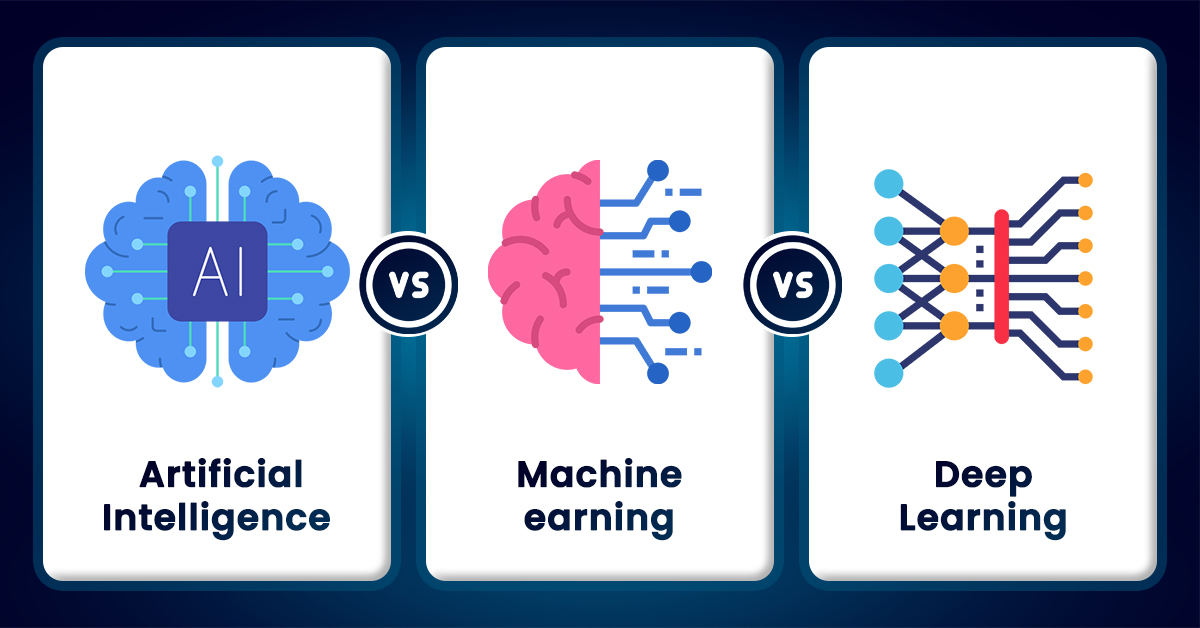
Meet Khushal Luniya – A Young Tech Enthusiast, AI Operations Expert, Graphic Designer, and Desk Editor at Luniya Times News. Known for his Brilliance and Creativity, Khushal Luniya has already mastered HTML and CSS. His deep passion for Coding, Artificial Intelligence, and Design is driving him to create impactful digital experiences. With a unique blend of technical skill and artistic vision, Khushal Luniya is truly a rising star in the tech and Media World.


AI vs ML vs DL
Deep Research & Technical Comparison of Artificial Intelligence, Machine Learning and Deep Learning
Introduction
Artificial Intelligence (AI), Machine Learning (ML) and Deep Learning (DL) are the foundational pillars of modern computing intelligence. While these terms are often used interchangeably, they represent distinct layers of technological evolution. Understanding their differences is essential to grasp how intelligent systems are designed, trained and deployed in real-world environments.





What is Artificial Intelligence (AI)
Artificial Intelligence is the broadest discipline focused on building systems capable of performing tasks that traditionally require human intelligence. These tasks include reasoning, decision-making, planning, perception and problem solving. Classical AI systems rely on symbolic logic, rule-based engines, heuristics and search algorithms.
Early AI systems such as expert systems operated using predefined rules and knowledge bases. Modern AI now combines symbolic reasoning with data-driven methods, forming hybrid intelligent architectures.
What is Machine Learning (ML)
Machine Learning is a specialized subset of AI that enables systems to learn patterns directly from data. Instead of being explicitly programmed with rules, ML models infer relationships through statistical learning and optimization techniques.
ML relies heavily on feature engineering, where domain knowledge is used to extract meaningful inputs from raw data. Common ML paradigms include supervised learning, unsupervised learning and reinforcement learning.
What is Deep Learning (DL)
Deep Learning is an advanced branch of Machine Learning inspired by the structure of the human brain. It uses artificial neural networks with multiple hidden layers to automatically learn hierarchical representations from raw data.
Unlike traditional ML, Deep Learning minimizes the need for manual feature engineering. With sufficient data and computational power, DL models can outperform other techniques in tasks involving images, audio and natural language.
Technical Architecture Comparison
AI Architecture
Rule-based logic, symbolic representations, decision trees, planning algorithms and knowledge graphs form the core of AI systems.
ML Architecture
Statistical models such as regression, support vector machines, clustering algorithms and ensemble methods trained on structured data.
DL Architecture
Multi-layer neural networks including CNNs, RNNs and Transformers requiring GPUs or TPUs for training.
Compute Power and Data Dependency
AI systems can operate with minimal data using logic and rules. ML models require moderate datasets to generalize patterns, while DL systems demand massive labeled datasets and high-performance hardware to reach optimal accuracy.
Interpretability and Transparency
Traditional AI and ML models are often interpretable, allowing engineers to trace decision logic. Deep Learning models, however, are frequently described as black boxes due to their complex internal representations.
Comparison Table
| Aspect | AI | ML | DL |
|---|---|---|---|
| Scope | Broad intelligence | Learning from data | Neural learning |
| Data Requirement | Low | Medium | Very High |
| Hardware | CPU | CPU / GPU | GPU / TPU |
Future Outlook
The future of intelligent systems lies in the convergence of symbolic AI, efficient ML and scalable Deep Learning. Research is moving toward more interpretable, data-efficient and generalizable architectures that combine reasoning with perception.
Khushal LuniyaFebruary 7, 2026